

Intel Core i3-10100 + B460 Motherboard Review
The Cadre i3-10100 is Intel's most affordable 4-core, 8-thread CPU ever. Coming in at a $122, that places it in straight competition with AMD'southward recently introduced Ryzen 3 3300X which costs $120. In case of both processors though, offering is somewhat express at the time and pricing can be a tad college or stock hard to come up by. We expect that to settle down eventually so we won't focus on that and but say these are $120 CPUs in direct contention.
Permit'south talk a bit about the Core i3-10100. Every bit the successor of the i3-9100, clock speeds are almost the aforementioned as we're withal looking at 3.6 GHz for the base with a 100 MHz increment for turbo to four.3 GHz. The key divergence betwixt the 2 is the utilise of Hyper-Threading, assuasive the 10100 to support 8 threads opposed to just 4. In terms of specs, the Core i3-10100 is very similar to 2022'due south Core i7-7700, which toll over $300 or more than twice as much as this i3 CPU.

When compared to the i7-7700, the Core i3-10100 has less L3 cache with 6 MB, though the i3-10300 which costs $20 more gets the full 8 MB. The same UHD Graphics 630 are in use, and we're looking at a 65 W TDP rating.
Intel Core i3-10100 vs. Core i7-7700

Speaking of TDP, when we reviewed the Core i5-10400 a week ago we did so without any power limits equally only Asus motherboards seem to enforce these limits. This upset a few people who claimed this wouldn't be indicative of functioning on more affordable B and H-series motherboards, and fair enough, this is something we should have touched on. Equally it turns out, that's non really the case, the i5-10400 volition deliver the exact aforementioned results on all H410 and B360 boards to what we showed on the Z490 lath. This isn't because nigh H410 and B360 boards won't attach to the Intel spec, simply because the 10400 doesn't really exceed the TDP.
Under heavy AVX workloads you're looking at a packet TDP of 64 watts, so the 10400 sneaks in there and won't trip any power limits. So to clarify, power limits enforced or non, the Core i5-10400 will deliver the aforementioned performance on all H410, B460 and Z490 motherboards. Thus the only performance advantage seen in more than expensive Z490 motherboards will be through memory overclocking.
Core i3 Generations

With that out of the mode, it goes without saying that the Cadre i3-10100 besides comes in under the 65W TDP envelope, reaching simply 41 watts in an AVX accelerated cadre-heavy workload. That doesn't hateful the CPU is only consuming 41 watts -- that's not how TDP ratings work, but we won't get into that here -- we've discussed how Intel and AMD's TDP ratings are defined in the past, the signal we need to brand is simply that motherboard blazon or quality won't influence performance for these parts.
Where this can get a problem is for the Core i7 and Core i9 models, but that's a review for another day.
The Core i3-10100 runs an all-core clock speed of 4.1 GHz with a max single core frequency of 4.iii GHz. Using the included box cooler it peaked at just 61C in our Blender stress exam and ran reasonably quiet.
We'd just like to note that comparing the operating temperature of the i3-10100 to something like the R3 3300X is a pointless do, y'all're better off just looking at power consumption because temperatures can easily cease up being an apples to oranges comparison. Where the temperature probe is located in the CPU can heavily influence the reading; a expert example of this can be seen when looking at AMD GPUs which include a hotspot readout also as an edge temperature which is oftentimes much lower. Still, for those not satisfied with that, the Ryzen 3 3300X using the Wraith Stealth box cooler reached 75C under the same test conditions while the R3 3100 reached 65C.

The Ryzen processors were tested on the Gigabyte X570 Aorus Main, 8th and ninth-gen Intel Cadre processors were tested on the Gigabyte Z390 Aorus Ultra, and the new 10th-gen Core processors on the Asus ROG Maximus XII Extreme. For the sake of exhaustiveness, nosotros've also tested the Core i5-10400 and Core i3-10100 on some B360 boards and found the performance to exist identical to that of the Z490 board running DDR4-2666 memory.
All setups were completed with an RTX 2080 Ti, 32GB of DDR4-3200 CL14 memory, and a Corsair Hydro H150i Pro 360mm all-in-one liquid cooler. Let's go into the results…
Benchmarks

Get-go upwardly, nosotros take Cinebench R20 multi-core results and here the 10100 managed to produce a score of 2172 pts, which is a substantial 37% performance uplift from the 9100F. That said the issue is also entirely expected, the 10100'south all core clock frequency is seven% lower than that of the 7700K, and so unsurprisingly it was 7% slower. The smaller L3 cache volition also contribute for some of that margin.
The R3 3300X was twenty% faster in this test and this suggests for core-heavy workloads the Ryzen processor is going to exist quite a tad faster.

As for unmarried-core performance, the 10100 is decent and while certainly not particularly stiff relative to the competition, these are the results you'd expect from an Intel processor capped at 4.3 GHz.

The seven-zip pinch results look quite similar to Cinebench multi-core. The 10100 provides a really nice pace frontwards from the 9100F, only at 20% slower than the 3300X it's outgunned in this test. Nosotros're as well looking at a further v% decline in performance when using the slower DDR4-2666 memory.

Moving over to decompression performance, we run across similar results for the 10100 using either DDR4-2666 or 3200 memory. Nosotros do see a big 41% performance improvement over the previous generation Cadre i3s which is slap-up news, nonetheless AMD's make new Ryzen iii 3300X is however almost 30% faster.

Here's a look at AES-256 multi-thread performance. To encrypt/decrypt a file using the AES algorithm, the file must undergo a ready of complex computational steps which tin be sped up dramatically using multi-core CPUs. That said the 10100 isn't a great deal faster than the 9100F in the SiSoft Sandra benchmark, despite it'due south Hyper-Threading back up and as a result the 3300X is up to 45% faster.
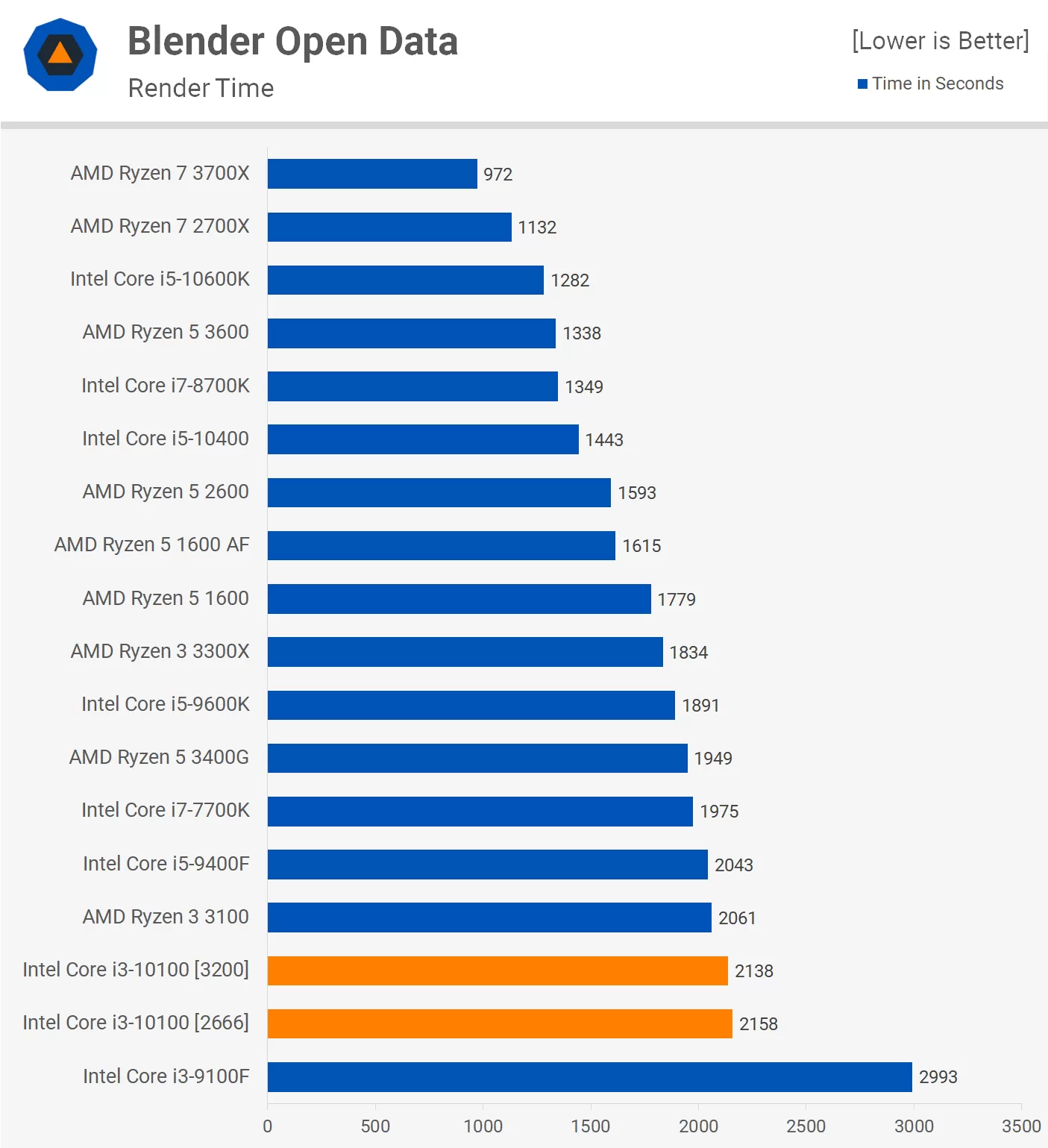
Where the 10100 buries the 9100F is in the Blender Open Information benchmark, where the newer Intel processor was 40% faster. That's a keen event and overall functioning is reasonably proficient despite the 10100 coming in nigh the lesser of our graph.

Again we're seeing impressive gains for the Core i3-10100 over the 9100F, this time improving performance in the V-Ray benchmark past a 33% margin. That improvement is overshadowed by the fact that the 3300X is nevertheless over 20% faster.

This time Ryzen 3 was only 11% faster in the Corona criterion, so one of Intel better showings in our productivity benchmarks. We're besides looking at an insane 56% performance uplift over the 9100F, then it would seem Intel's simultaneous multithreading is well utilized in this benchmark.

Hither's a look at lawmaking compilation functioning and this time nosotros're looking at a 37% functioning improvement for the Core i3-10100 over the 9100F.

The Core i3-10100 managed to match the Cadre i7-7700K in the DaVinci Resolve Studio sixteen benchmark. Compared to Ryzen, the R3 3100 was 3% faster and the 3300X was a more convincing seven% faster. Not big margins as before, but the trend of Ryzen 3 winning on the productivity side continues.
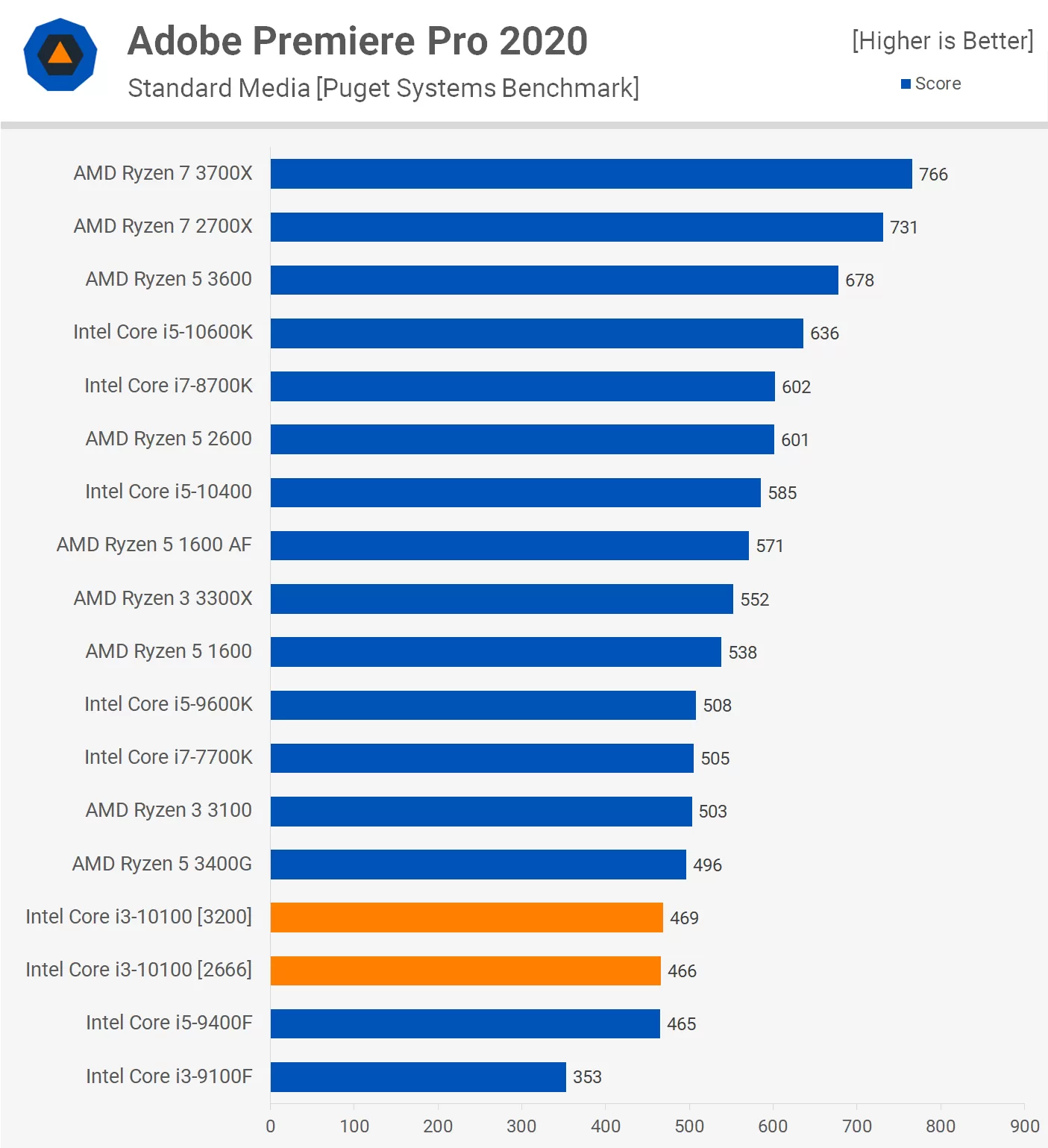
This time nosotros're looking at Cadre i5-9400F similar performance in the Adobe Premiere Pro benchmark and that meant the R3 3100 was six% faster than the 3300X eighteen% faster.

The 10100 performs quite well in the Adobe Photoshop benchmark, matching the Ryzen iii 3100 and coming in just backside the Core i7-7700K. Surprisingly though the 3300X was still 17% faster.

Our final application benchmark is Adobe Subsequently Furnishings, where the 10100 was slightly slower than the R3 3100 and 3300X, and then pretty competitive performance in this test.
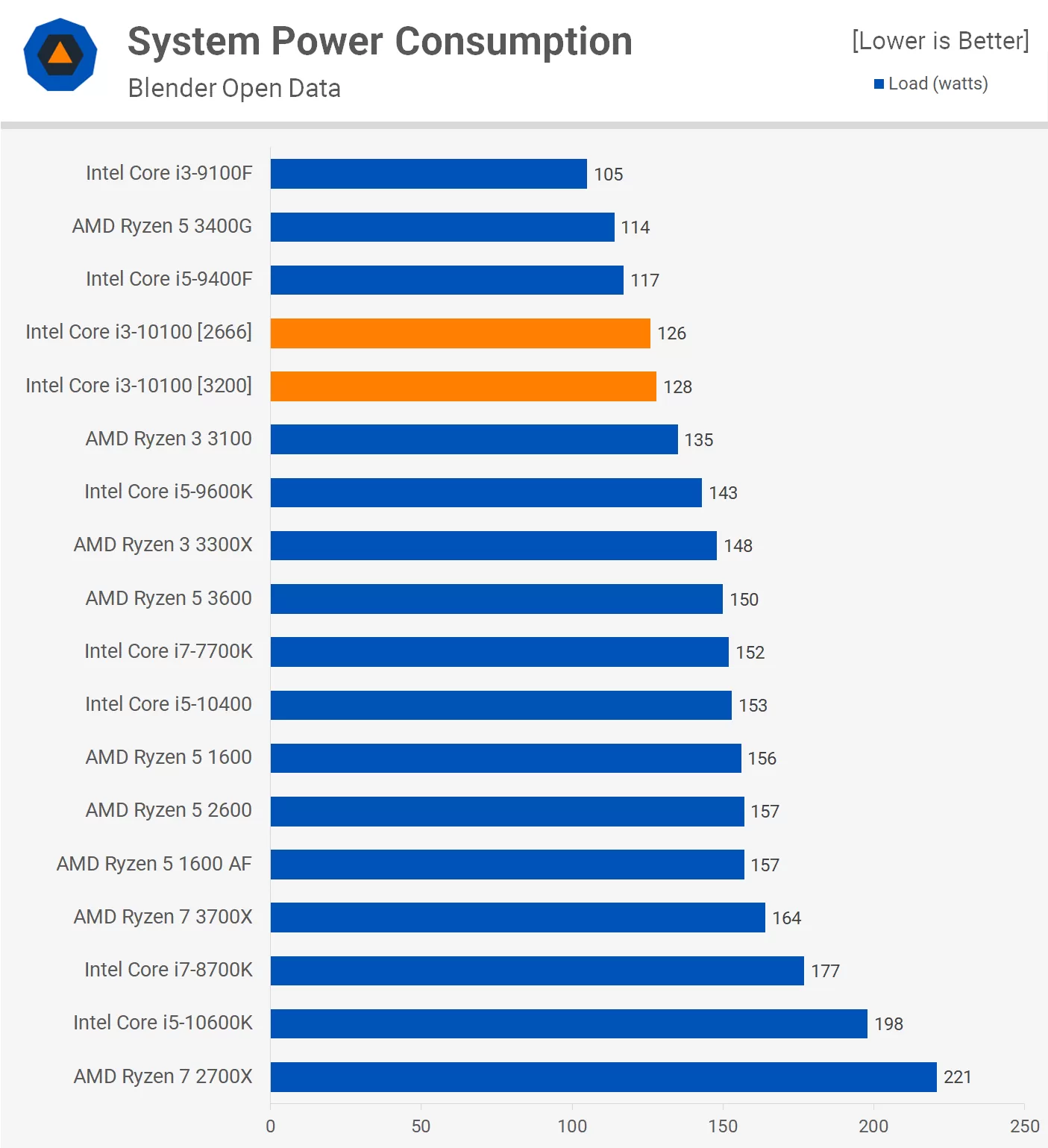
When it comes to power consumption, nosotros see that the Core i3-10100 uses slightly less ability than the Ryzen iii 3100 and 3300X in this job, yet y'all have to remember that the 3300X was 17% faster in this test, and then performance per watt still goes in AMD'due south favor. Regardless, when talking virtually total system consumption of under 150 watts for a desktop PC, it doesn't matter likewise much.
Gaming Benchmarks
At present information technology'southward time for the gaming benchmarks with Battlefield V at running at 1080p with the GeForce RTX 2080 Ti. It's not necessary to explain again why we're using a $one,000+ graphics card to examination the gaming performance of budget CPUs, we've explained why this is in the past, so read on if you're wondering. TL;DR: nosotros don't believe in testing CPUs without a potent GPU bottleneck.
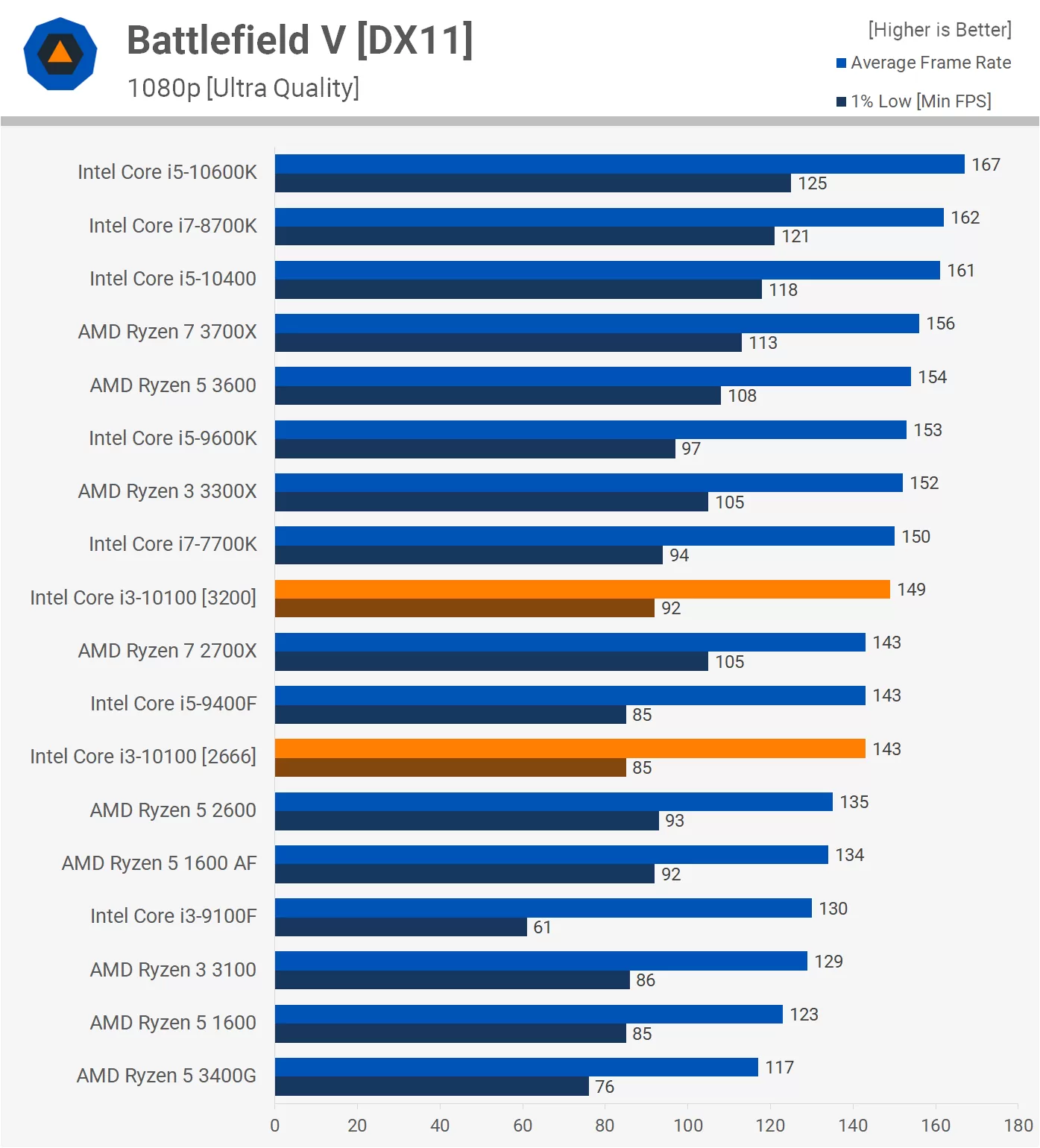

The 10100 is able to roughly match the 7700K when paired with DDR4-3200 memory. It was too a mere 2% backside than the 3300X when comparison average frame rates, yet the one% low performance was 12% lower. Notwithstanding performance overall was pretty practiced and a massive improvement over the 9100F which provides inconsistent operation in this championship.
Interestingly, increasing the resolution which can increase CPU load in games sees the 10100 fall behind the 3300X past a 19% margin when comparing 1% low performance. Despite both having a 4-core/viii-thread configuration, the 3300X manages to evangelize the more consistent experience in Battlefield 5 and that'due south probable a result of featuring over twice as much L3 cache.


Next up we have Far Cry New Dawn. The 1080p information shows the 10100 performing a little slower than the 3300X when using DDR4-3200 retentiveness, though once more information technology'southward the one% lows that endure the near and hither the 3300X was 15% faster. Meanwhile, the faster 3200 retention additional the boilerplate frame rate by vii%, simply only improved the 1% low figure past simply three%.
Moving to 1440p shows the 10100 is only able to match the 9100F. Both operate at similar clock speeds but we've seen many instances where Hyper-Threading can hamper gaming functioning. That said, the 7700K was xvi% faster in average frame rates, and so that would hint that the smaller L3 cache chapters is largely to blame.


Gears Tactics results has the i3-10100 performing slower than the 7700K once again. In fact, hither it's only able to roughly match the 9100F, with x% better i% low performance. But even so, we're looking at gaming operation where the 3300X is some xvi% faster.
That margin is heavily reduced at 1440p and now the 3300X is merely a few frames faster, merely however non a good result for the 10100.


The margins seen in Rainbow 6 Siege don't paint a dainty moving picture for the i3-10100 either. Here the 3300X was 21% faster when comparison i% depression information. Granted, the Core i3 processor managed over 160 fps at all times, so the margins might be somewhat irrelevant.
Even at 1440p the 3300X was still 7% faster when comparison 1% low data. While you probably won't be able to notice the small difference, it's shocking to see Intel at a disadvantage when it comes to gaming.


Ghost Recon Breakpoint isn't specially CPU demanding and here the i3-10100 had no trouble matching the 3300X to come in just behind the higher-end, more expensive processors.
Nosotros see even slimmer margins at 1440p, where the 10100 was able to deliver the same gaming experience as the 10600K.

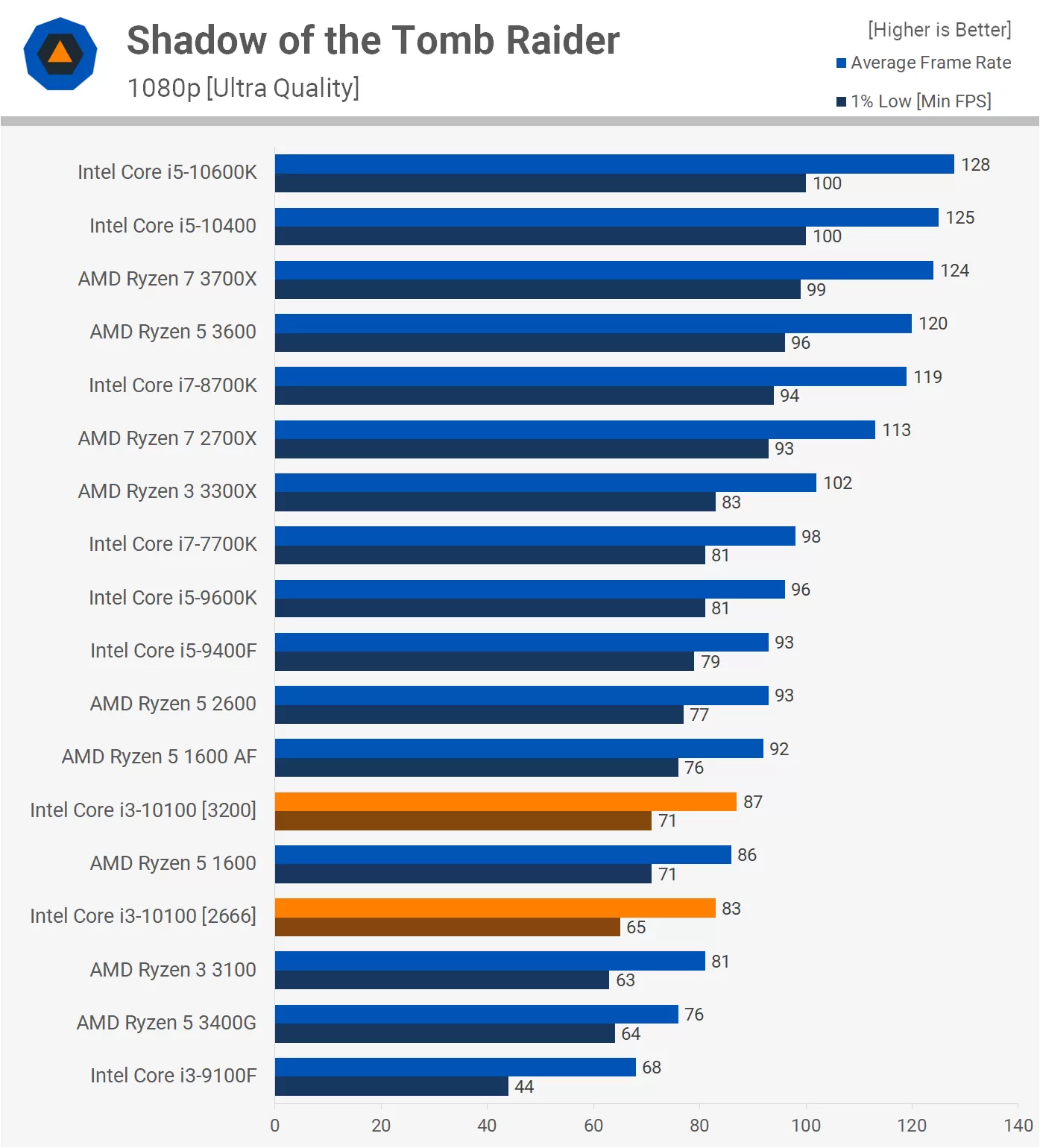
Conversely, Shadow of the Tomb Raider is very CPU demanding and it shows when the iv-thread Core i3-9100F is unable to evangelize smooth frame rates. With the addition of Hyper-Threading, the Core i3-10100 can deliver upward to 61% better 1% low operation, allowing it to match the Ryzen 5 1600, even if that's backside the Ryzen 3 3300X which averaged 102 fps.
The i3-10100 still trailed the 3300X at 1440p. Here the Ryzen scrap was 9% faster when comparison the DDR4-3200 configurations.


Cerise Dead Redemption 2 shows subpar functioning for the Core i3-10100 when compared to the R3 3300X. Fifty-fifty at 1440p the i3-10100 continues to trail, just with frame rates at or higher up sixty fps with the DDR4-3200 memory configuration, the gaming experience is still acceptable.
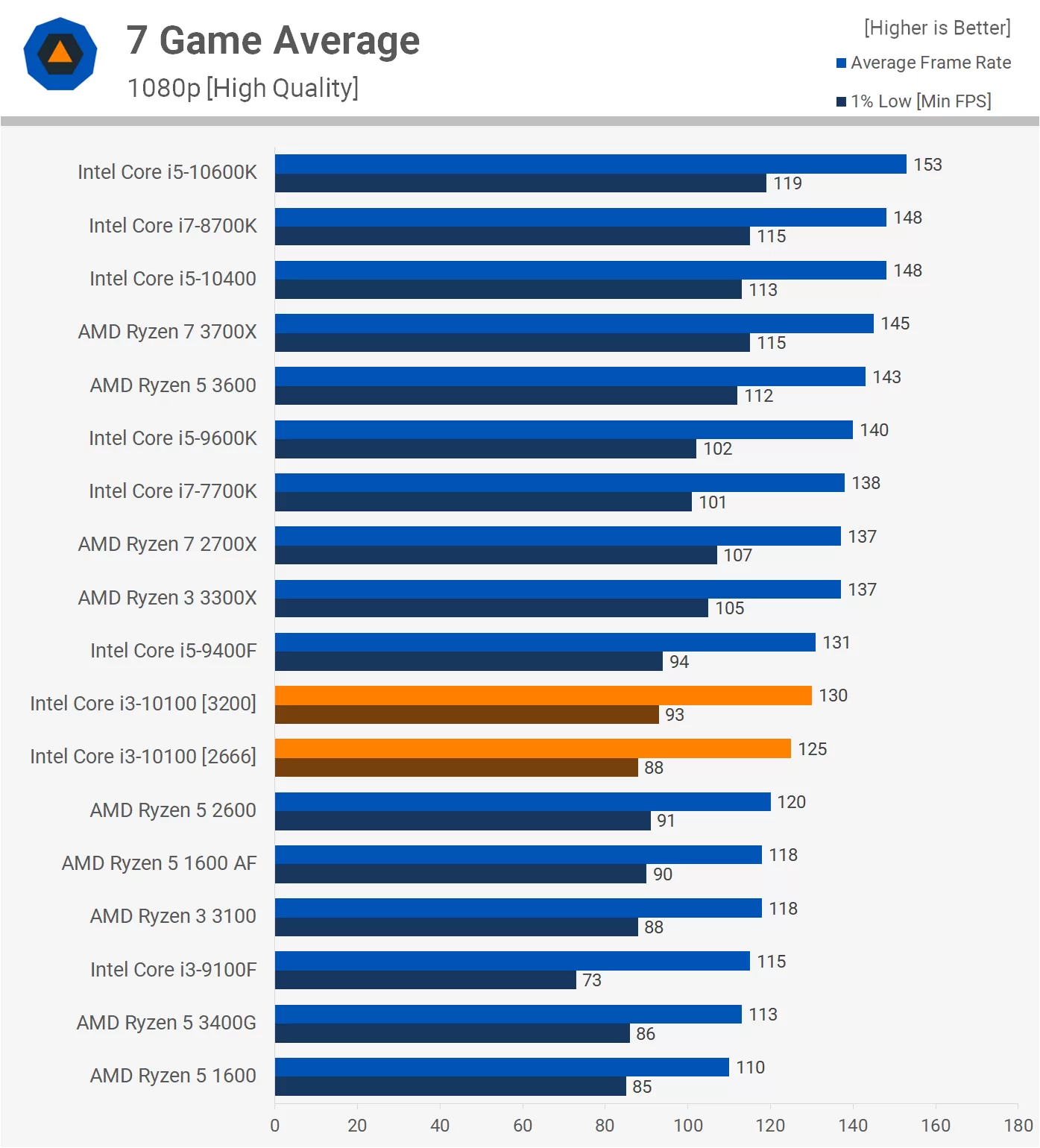
Taking a quick look at the average frame rate operation across the 7 games we tested for this review, on average the Cadre i3-10100 was simply 5% slower than the Ryzen 3 3300X, and typically anything inside a v% margin we deem a draw. The i% low performance however is but as important, here the 3300X displayed more consequent gaming functioning confronting the Core i3-10100 which was 11% slower in this metric.
The faster memory doesn't brand a huge difference for the Core i3 processor, though we are looking at a 6% improvement for the 1% depression. When looking at the DDR4-3200 configuration we run across that the 10100 is comparable to the Core i5-9400F which isn't unexpected, nor is the fact that information technology was 6% slower than the 7700K on average.
A Word Near B460 Motherboards, What Nosotros Learned
You may want to know that the terminal part of the Core i3-10100 testing was carried out on the MSI B460 Mortar, simply nosotros didn't carp graphing that information equally technically you've simply seen the results. On this board the 10100 performs exactly like the DDR4-2666 configuration just shown. Every bit noted before, this B460 board doesn't limit the 10100, and the same is true for the Cadre i5-10400.
Given what we've observed with the 10400 beingness right on the 65 watt TDP limit, parts like the i5-10500 will start to see ability limits come up into play on boards with a 65 watt limit, though the operation hit will be extremely balmy in that example. You probably won't see a harsh reject in all-core performance on a TDP limited lath until y'all attain and become beyond the Core i5-10600K. The 10600K, for instance, will come across the parcel TDP go as high equally 110 watts in an AVX workload.

In the case of the MSI B460 Mortar, this lath has a 255W sustained boost limit, and so even the 10900K will run without power limits, maintaining an all-core frequency of 4.8 GHz which is extremely impressive, though nosotros've yet to properly measure VRM thermals.
Something else worth addressing, coming from the i5-10400 review, some readers commented that reviews should employ the box cooler when benchmarking. The Cadre i5-10400 and i3-10100 are past no means thermally limited by the Intel box libation, performance will be identical whether you employ the box cooler or the most exotic custom loop setup you tin can recall of. Not thermally limited, not going to make any deviation to the benchmarks.

As for the Core i3-10100, what practice we make of it?
Coming in at $120, that'due south the same toll as the 3300X. In terms of gaming performance they're pretty similar, the i3-10100 seems to have an advantage in less demanding titles whereas the 3300X showed solid gains in games such as Shadow of the Tomb Raider and that suggests moving forward it might be the better gaming CPU, but for at present at least they can trade blows.
Not surprisingly -- many reviews in a row against Zen two later on -- the trouble for the i3-10100 comes when looking at productivity performance where this CPU is considerably slower. Some Intel fans will claim no one does any real work with a Core i3, or any budget processor for that matter, but that's simply non true. The list of people who would desire a inexpensive simply effective CPU for productivity tasks is almost endless, engineering students, apprentice content creators, programmers, and the list goes on.
For these people with a little over $100 to spend, the Ryzen 3 3300X is more appealing, often offering at to the lowest degree 20% better performance. When it comes to general operation, web browsing, emails, word documents, and that sort of stuff, it really won't affair. Either CPU will crush those tasks and the advantage the Core i3-10100 has for those users is its integrated GPU.
When it comes to full general functioning, spider web browsing, emails, discussion documents, and that sort of stuff, it really won't matter. Either CPU will beat those tasks and the advantage the Core i3-10100 has for those users is its integrated GPU.
It's of course a weak GPU implementation from a operation perspective, however for desktop work it is capable of handling up to three monitors and up to 4K resolution at 60Hz (the exact combination will depend on a number of factors like motherboard/output support). Thus, the 10100 makes sense and tin exist a more price effective option for some.

Looking at other costs similar the motherboard, the MSI B460 Mortar should be coming in nearly the same price every bit the B450 Tomahawk, though that will limit you to DDR4-2666 memory which makes the i3-10100 a little slower. Every bit nosotros said in our Core i5-10400 review, for Intel to be truly competitive at these lower cost points they should definitely open memory overclocking on the B and H-series motherboards.
The Cadre i3-10100 is a massive step upwardly from the previous 9th generation Core i3s, but it does have to debate with the Ryzen 3 3300X, and that'southward a problem. The Ryzen CPU is just equally fast for gaming, has faster application performance and can be overclocked for even ameliorate results, it also supports loftier frequency memory on affordable B450 motherboards.
Shopping Shortcuts:
- Intel Core i3-10100 on Amazon
- Intel Core i5-10400 on Amazon
- AMD Ryzen 3 3300X on Amazon
- AMD Ryzen 3 3100 on Amazon
- AMD Ryzen five 3600 on Amazon
- Intel Core i5-10600K on Amazon
- AMD Ryzen 9 3900X on Amazon
- GeForce RTX 2080 Ti on Amazon
- GeForce RTX 2060 Super on Amazon

Source: https://www.techspot.com/review/2033-intel-core-i3-10100/
Posted by: cowellquission.blogspot.com
0 Response to "Intel Core i3-10100 + B460 Motherboard Review"
Post a Comment